
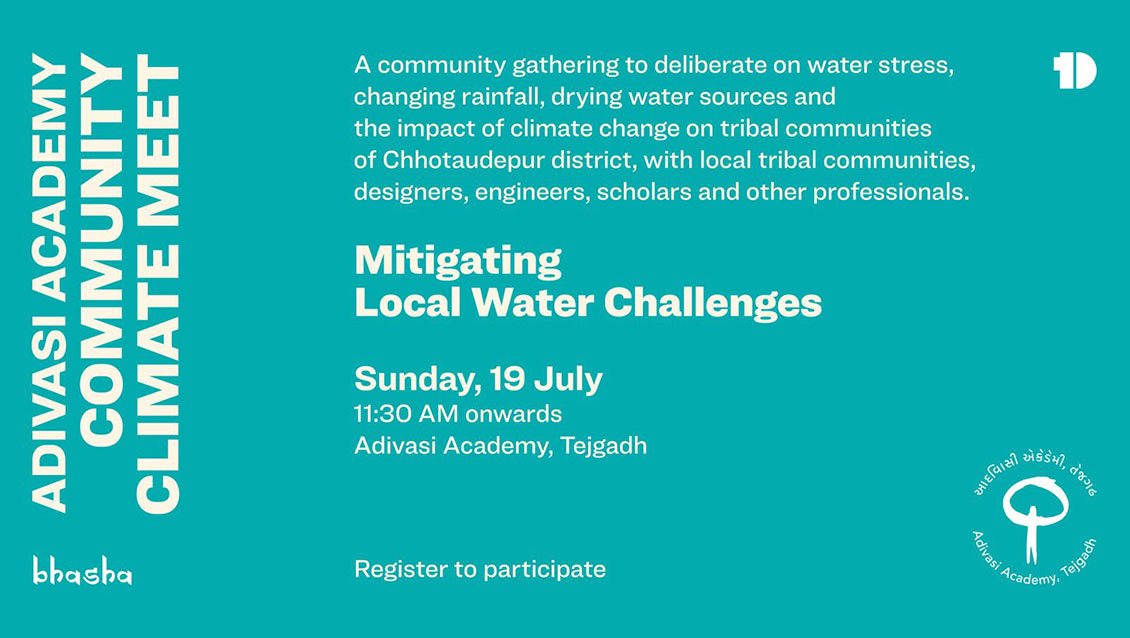
A Deliberation on Water, Tribal Communities and Local Ecological Futures
Date: 19 July
Time: 11:30 AM onwards
Venue: Adivasi Academy, Tejgadh
Participants: Local tribal communities of Chhotaudepur district
Also invited: Designers, engineers, scholars, planners, water practitioners, environmental workers, policy practitioners, development professionals and concerned citizens
Organised by: Bhasha, Adivasi Academy and Tribal Design Forum
Background
Water is one of the most immediate ways in which climate change, ecological disruption and development pressures are experienced by local communities. For tribal communities, water is not only a resource. It is part of everyday life, farming, forests, animals, food systems, rituals, health, mobility and community memory.
Across many regions, communities are witnessing changes in rainfall patterns, drying streams, shrinking ponds, declining groundwater, reduced soil moisture, water contamination, pressure on traditional water sources and growing uncertainty around agriculture. These changes are deeply connected to deforestation, extraction, concretisation, mining, land-use change, loss of commons and the disruption of local ecological systems.
As temperatures rise, the question of water becomes even more urgent. Heat and water are connected. When tree cover is lost, when soil is exposed, when streams are disturbed, when water bodies are neglected, the land becomes hotter and drier. The burden of this is often carried by communities who live closest to land and depend most directly on local ecological systems.
Yet tribal communities have historically protected forests, streams, soil, water bodies, seeds, biodiversity and seasonal knowledge. Their relationship with water is based on observation, restraint, sharing, reciprocity and survival. This knowledge must be recognised as central to any meaningful conversation on water security and climate resilience.
Rationale
The proposed deliberation on water is being organised as a continuation of the conversation on rising temperatures and tribal communities. If the first gathering asks how heat is affecting communities, the second gathering asks how water systems are changing, and what local responses are possible.
The purpose is to bring together local tribal communities, designers, engineers, scholars, planners and other professionals to listen, deliberate and identify practical community-led directions.
This meeting does not treat water as merely an engineering issue. It approaches water as an ecological, cultural, social and justice question.
Who has access to water? Who walks for it? Which sources are drying? Which traditional systems are being neglected? How are forests, hills, soil and water connected? How is water stress affecting women, children, elders, farmers, animals and daily life? What can local communities teach us about water conservation, seasonal cycles and ecological balance?
Central Question
Why should tribal communities face water stress when they have historically protected the forests, streams, soil and ecological systems that sustain water?
Objectives
The deliberation aims to:
- Listen to local tribal communities on changing water conditions in Chhotaudepur district.
- Understand how water stress is affecting farming, forests, drinking water, livestock, health, women’s work, livelihoods and everyday life.
- Document local observations on rainfall, streams, ponds, wells, soil moisture, tree cover and seasonal changes.
- Identify traditional and contemporary community practices related to water conservation, sharing and management.
- Explore how design, engineering, planning, policy and community action can support local water resilience.
- Develop possible directions for community-led water mapping, restoration and conservation.
Themes for Deliberation
- Water and Everyday Life
- Changing Rainfall and Drying Sources
- Forests, Soil and Water
- Water, Labour and Inequality
- Local Water Knowledge
- Design, Planning, Policy and Community Interventions
Local solutions will require design, planning, policy and community action to work together. Water resilience cannot be built only through large schemes. It must also emerge from local ecology, local materials, community memory and everyday practice.
Designers can help visualise water systems, settlement patterns, shade, public spaces and community infrastructure. Engineers can support rainwater harvesting, check dams, drainage, soil moisture retention, wastewater reuse and low-cost water systems. Planners can help protect commons, tree cover, ponds, walking routes, grazing lands and water bodies. Policy makers can ensure that schemes for water, forests, agriculture, rural development and tribal welfare respond to the actual needs of communities.
But all interventions must begin with listening. Tribal communities must be treated as knowledge-holders and decision-makers, not as passive beneficiaries.
Expected Outcomes
The deliberation is expected to lead to:
- A clearer understanding of water-related challenges faced by tribal communities in Chhotaudepur district.
- A set of community observations on rainfall, water sources, soil, forests, farming and everyday water use.
- Identification of local water conservation and restoration possibilities.
- A preliminary direction for community-led water resilience work around Adivasi Academy and nearby villages.
- A stronger framework for collaboration between tribal communities and professionals.
- A public statement that water justice must recognise tribal communities as knowledge-holders, custodians and partners.
Conclusion
Water is life, memory and community. It carries the relationship between land, forest, soil, animals, people and seasons
As climate change, deforestation, extraction and development pressures intensify, water systems are becoming more fragile. Tribal communities, who have long lived with ecological restraint and deep knowledge of land-water relationships, should not be left to face water stress alone.
This deliberation is a step towards listening to local experience, respecting community knowledge and imagining practical local solutions.
Those who protect forests, soil and streams must be central to the future of water.