
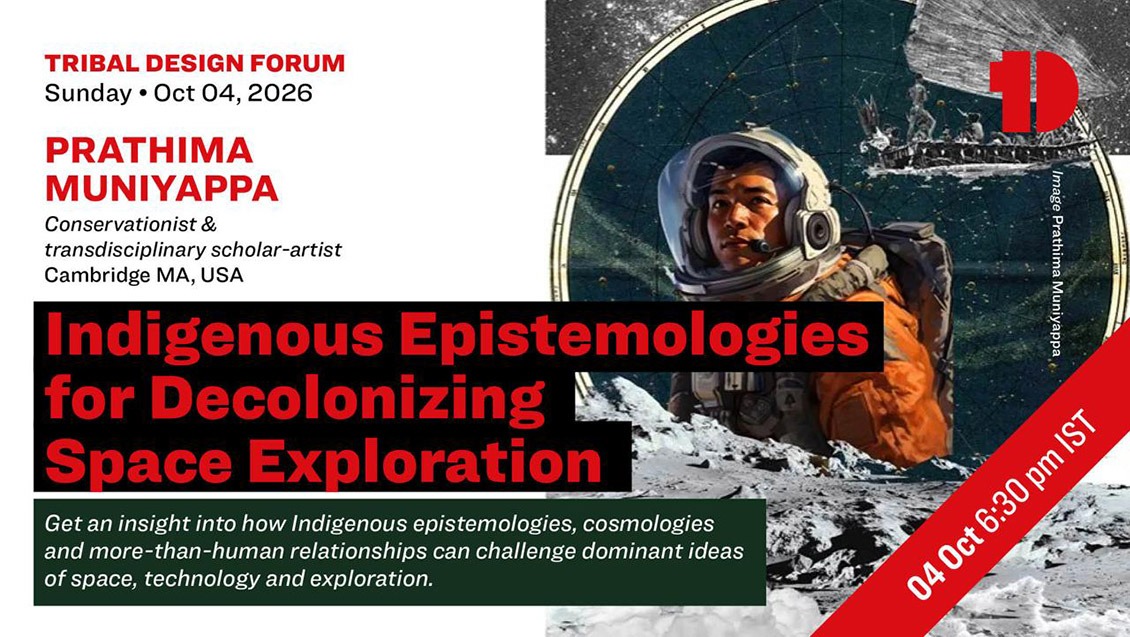
About TDF Session 256
More details on the session and the Zoom link available on Registration.
About Dr. Prathima Muniyappa
Conservationist & transdisciplinary scholar-artist
Cambridge MA, USA
Prathima Muniyappa is a conservationist and transdisciplinary scholar-artist whose research mobilizes Indigenous epistemologies as critical frameworks for reconfiguring technoscientific futures. Her work interrogates the epistemic assumptions embedded in space exploration, synthetic biology, and extended intelligence. Drawing from immersive fieldwork with communities across the globe, her research examines how ritual technologies, oral cosmologies, and multispecies relations generate alternative modalities of knowledge, ethics, and design.
As a PhD candidate at the MIT Media Lab and a research assistant in the Space Enabled group, her work interrogates the epistemic assumptions embedded in space exploration, synthetic biology, and extended intelligence. Drawing from immersive fieldwork with communities across the globe, she examines how ritual technologies, oral cosmologies, and multispecies relations generate alternative modalities of knowledge, ethics, and design.
Her PhD dissertation, Designing for the CthulhuCosmos: Toward a Speculative Cosmopolitics of Indigenous Epistemologies in Space, articulates a decolonial and pluriversal framework for space ethics that foregrounds Indigenous epistemologies, relationality, cohabitation, and non-anthropocentric design logics. By treating cosmologies as living ontologies rather than symbolic artifacts, Muniyappa seeks to reorient dominant trajectories of scientific advancement toward forms of speculative praxis grounded in reciprocity, aesthetic refusal, and epistemic justice.
Prior to MIT, she completed a Master in Design Studies in Critical Conservation at Harvard University’s Graduate School of Design as a Fulbright Fellow, where she explored sacred groves and Indigenous conservation paradigms through the lens of non-dualist design praxis. Her work centers methodologies that emerge from situated knowledges, relational ontologies, and cosmopolitical accountability. Muniyappa approaches pedagogy as an act of epistemic disobedience and scholarship as a form of worlding. Her work intervenes in extractive paradigms of research and design, proposing instead a framework of critical accompaniment – one that privileges first-voice narratives, ceremonial technologies, and more-than-human accountability as essential to the work of reimagining planetary futures.
For more information on her work, visit:
https://www.prathimamuniyappa.com