
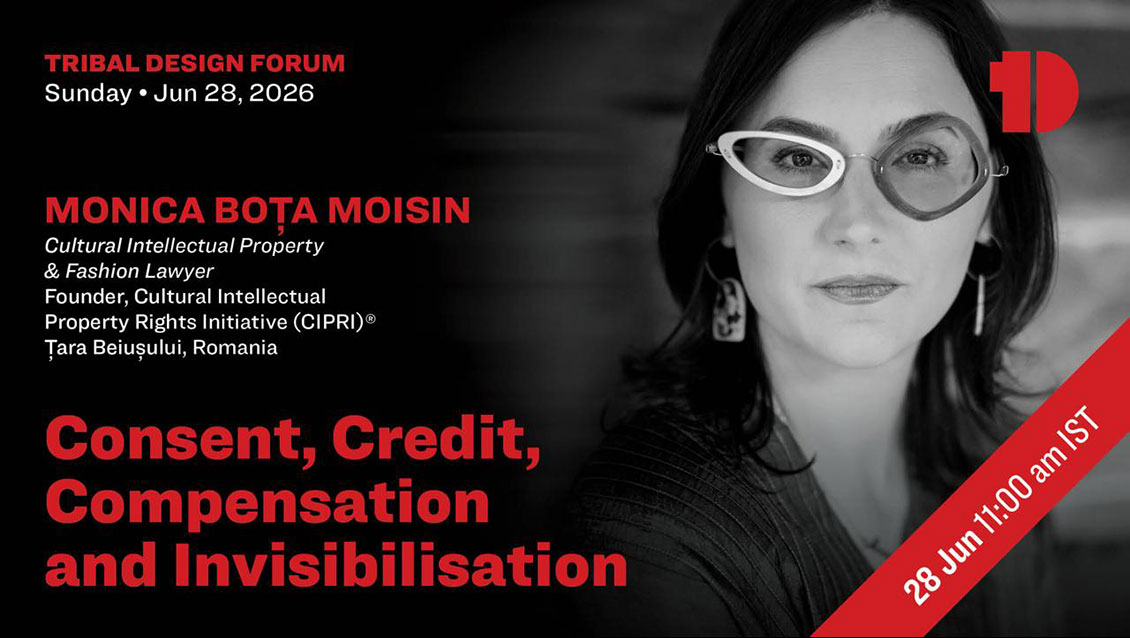
About TDF Session 253
More details on the session and the Zoom link available on Registration.
About the Talk
Consent, Credit, Compensation and Invisibilisation
This talk examines how Indigenous Peoples, ethnic groups, local autochthonous communities, craftspeople, and traditional knowledge custodians are often celebrated as sources of inspiration while being simultaneously erased from authorship, ownership, benefit, and decision-making. Drawing from Monica Boța Moisin’s work on Cultural Intellectual Property and the 3C Rule Consent. Credit. Compensation ®, the talk will explore why ethical engagement with Traditional Knowledge and Traditional Cultural Expressions must go beyond aesthetic appreciation or symbolic acknowledgement.
The fourth dimension of the conversation, Invisibilisation, asks what happens when communities are present in the work but absent from the record; when their knowledge is used but their names are missing; when their cultural systems are translated into products, exhibitions, policies, or design narratives without custodianship, traceability, fair participation or and benefit-sharing. The session will reflect on how law, design, fashion, heritage, and institutional practice can move from extraction to accountability by recognizing communities not merely as “inspiration”, but as knowledge holders, rights-bearing custodians, and co-creators.
At its core, the talk invites us to ask: Who gave consent? Who receives credit? Who is compensated? And who remains invisible even when the knowledge they nurture and sustain with care and responsibility is everywhere?
About Monica Boța Moisin
Founder, Cultural Intellectual Property Rights Initiative ®
Cultural Intellectual Property & Fashion Lawyer
Țara Beiușului, Romania
Monica Boța Moisin is a traditional custodian from Țara Beiușului, Romania. She is a Cultural Intellectual Property and fashion lawyer, cultural sustainability practitioner, and systems thinker working at the intersection of law, fashion, intangible cultural heritage, Traditional Knowledge, Traditional Cultural Expressions, biodiversity, and community rights. She has over a decade of international experience and is recognized as an Ashoka Fellow from Romania since 2024.
She is the founder of the Cultural Intellectual Property Rights Initiative ® (CIPRI), WhyWeCraft ®, and the Cultural Sustainability Academy – The Knowledge Hub for Cultural Sustainability®. Through these platforms, Monica has developed legal, educational, and advocacy tools that help Indigenous Peoples, ethnic groups, local communities, craftspeople, and traditional knowledge custodians to protect, articulate, and negotiate the value of their cultural knowledge and expressions.
Monica is best known for proposing the 3C Rule Consent. Credit. Compensation ® a soft-law framework for building fair and equitable relationships between creative industries and custodians of Traditional Knowledge and Traditional Cultural Expressions. The framework asks that any use of cultural knowledge, craft practices, designs, or expressions be rooted in prior consent, proper acknowledgement, and fair compensation to the source community or knowledge custodians.
Her work challenges the limits of conventional intellectual property law, especially where collective, intergenerational, oral, place-based, or community-held knowledge does not fit neatly into individual ownership models. Monica uses the concept of Cultural Intellectual Property to create pathways through which communities can move from being treated as sources of inspiration to being recognized as knowledge partners, rights holders, custodians, and co-creators.
Her practice spans legal consulting, cultural sustainability strategy, field consultations, legal literacy programmes, workshops, lectures, and policy engagement. She has worked with institutions and frameworks connected to WIPO, the UN Convention on Biological Diversity, the UNESCO 2003 ICH Convention, and her 3Cs framework has influenced fashion education, industry practice, and policy conversations.
Monica’s work is deeply relevant to conversations on tribal knowledge, design, authorship, cultural misappropriation, biocultural diversity, and benefit-sharing. Her approach insists that traditional knowledge is not a static cultural relic or museum object, but a living system carried by communities, embedded in land, language, memory, ecology, craft, and identity.
In Laos, Monica’s work with the Oma People supported the mapping and protection of textile motifs and cultural expressions through a consent-based community process. In India, her work has included support for the Mahila Print collective in Bagru, helping artisans use the 3Cs framework to present, protect, and license their work on fairer terms.
Her personal philosophy is also shaped by memory, clothing, and intergenerational inheritance. She has spoken of being inspired by the life stories and textile knowledge of her grandmothers, and describes clothing as identity, belonging, journey, story, and one of the most intimate connections people form in a lifetime.
At a time when design, fashion, sustainability, and cultural industries are increasingly drawing from Indigenous and local knowledge systems, Monica Boța Moisin’s work offers a critical ethical and legal vocabulary: no extraction without consent, no inspiration without credit, no cultural use without compensation, and no sustainability without custodianship.