
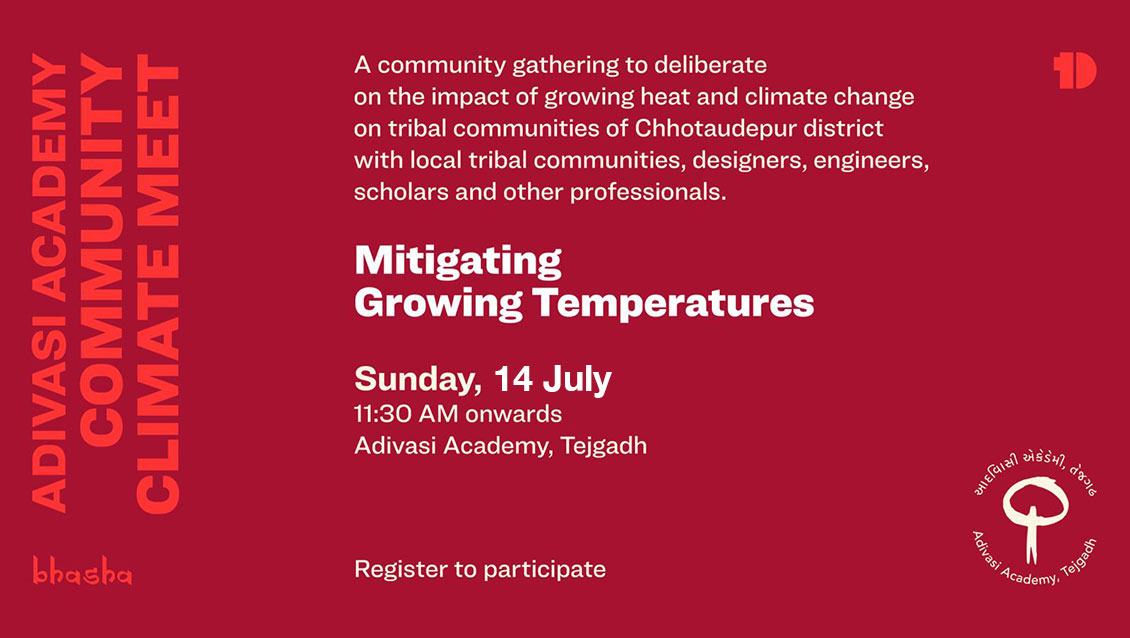
A Deliberation on Rising Temperatures, Tribal Communities and Local Climate Solutions
Date: 14 July
Time: 11:30 AM onwards
Venue: Adivasi Academy, Tejgadh
Participants: Local tribal communities of Chhotaudepur district
Also invited: Designers, engineers, scholars, planners, policy practitioners, architects, development professionals, environmental workers and concerned citizens
Organised by: Bhasha, Adivasi Academy and Tribal Design Forum
Background
Across India, rising temperatures are becoming one of the most visible and immediate signs of climate change. Heat is no longer only a seasonal discomfort. It is increasingly affecting health, livelihoods, farming, water access, forests, housing, mobility, animals and everyday community life.
For tribal communities, this impact is especially severe because many people live and work in direct relationship with land, forests, fields, rivers, hills, livestock and open skies. Heat is experienced not only as a number on a weather report, but as a bodily and social reality. It is felt while walking long distances, collecting forest produce, working in fields, grazing animals, building homes, accessing water, caring for children and elders, and sustaining daily life in exposed conditions.
At the same time, the roots of rising heat cannot be separated from wider patterns of rapid urbanisation, deforestation, extraction, concretisation, mining, loss of commons, shrinking tree cover and the disruption of ecological systems. Forests that once cooled the land are disappearing. Water bodies are being disturbed. Hills are being cut. Concrete surfaces are expanding. Landscapes are becoming hotter, harder and less able to sustain life.
Yet the people who often suffer most from these changes are not the ones who created the crisis. Many urban populations experience heat through air-conditioned rooms, vehicles, cooling appliances, shaded institutions, weather apps and packaged resources. But communities living closer to land often face heat directly, without adequate protection, infrastructure or policy attention. This raises an urgent ethical and practical question:
Why should tribal communities be at the receiving end of rising temperatures, when they have historically protected forests, water, soil, seeds, biodiversity and ecological balance?
Rationale
This deliberation is being organised to create a space where local tribal communities, designers, engineers, scholars and other professionals can come together to understand the impact of rising temperatures and explore local responses.
The purpose is not to treat tribal communities as passive victims of climate change. Tribal communities are knowledge-holders. Their relationship with land, materials, water, shade, soil, seasons, seeds, housing and community life contains deep ecological intelligence. Their knowledge systems are not abstract theories. They are lived practices of adaptation, restraint, repair and survival.
However, modern systems of development, planning and policy often fail to recognise this knowledge. In many cases, they extract from tribal lands, resources and traditions while leaving communities to bear the burden of ecological damage. Climate change, therefore, is not only an environmental issue. It is also a question of justice, dignity, design, planning and public responsibility.
The deliberation seeks to begin from local experience.
- What are people already observing?
- Which water sources are drying?
- Which crops are affected?
- Which forest species are changing?
- How is heat affecting health, work, animals, mobility, housing and community life?
- What practical measures are already being taken locally?
- What more can be done?
Central Question
Why should tribal communities be at the receiving end of rising temperatures?
This question invites reflection on climate justice, ecological responsibility and the unequal burden of heat. It asks whether those who have lived with and protected land-based systems should be made to suffer the consequences of development models that have ignored ecological balance.
Objectives
The deliberation aims to:
- Listen to the experiences of local tribal communities regarding rising temperatures and changing ecological conditions.
- Understand how heat is affecting water, forests, farming, livestock, health, housing, livelihoods and everyday life.
- Identify local knowledge, practices and community responses that can help mitigate the impact of rising heat.
- Explore how design, engineering, planning, policy and community action can work together to create practical local solutions.
- Encourage respectful collaboration between tribal communities and professionals, with communities recognised as knowledge-holders and decision-makers.
- Begin shaping a community-led climate response framework rooted in local ecology, local materials, local memory and local decision-making.
Themes for Deliberation
- Impact of Rising Temperatures
- Heat, Land and Livelihoods
- Rapid Urbanisation, Deforestation and Concretisation
- Tribal Knowledge and Ecological Memory
- Design, Planning, Policy and Community Interventions
Conclusion
Rising temperatures are not affecting everyone equally. Those who live under open skies, work with land, depend on forests and water, and sustain everyday life through bodily labour are among the first to feel the force of climate change.
Tribal communities have long protected ecological balance through knowledge systems rooted in restraint, reciprocity and respect for land. Yet they are increasingly placed at the receiving end of environmental damage caused by development models that often ignore their knowledge and rights.
This deliberation is a step towards listening, learning and acting differently.
Those who protected the land should not be the first to suffer from a hotter world. Any serious response to climate change must begin with the people who know the land, live with the land and continue to carry its memory.